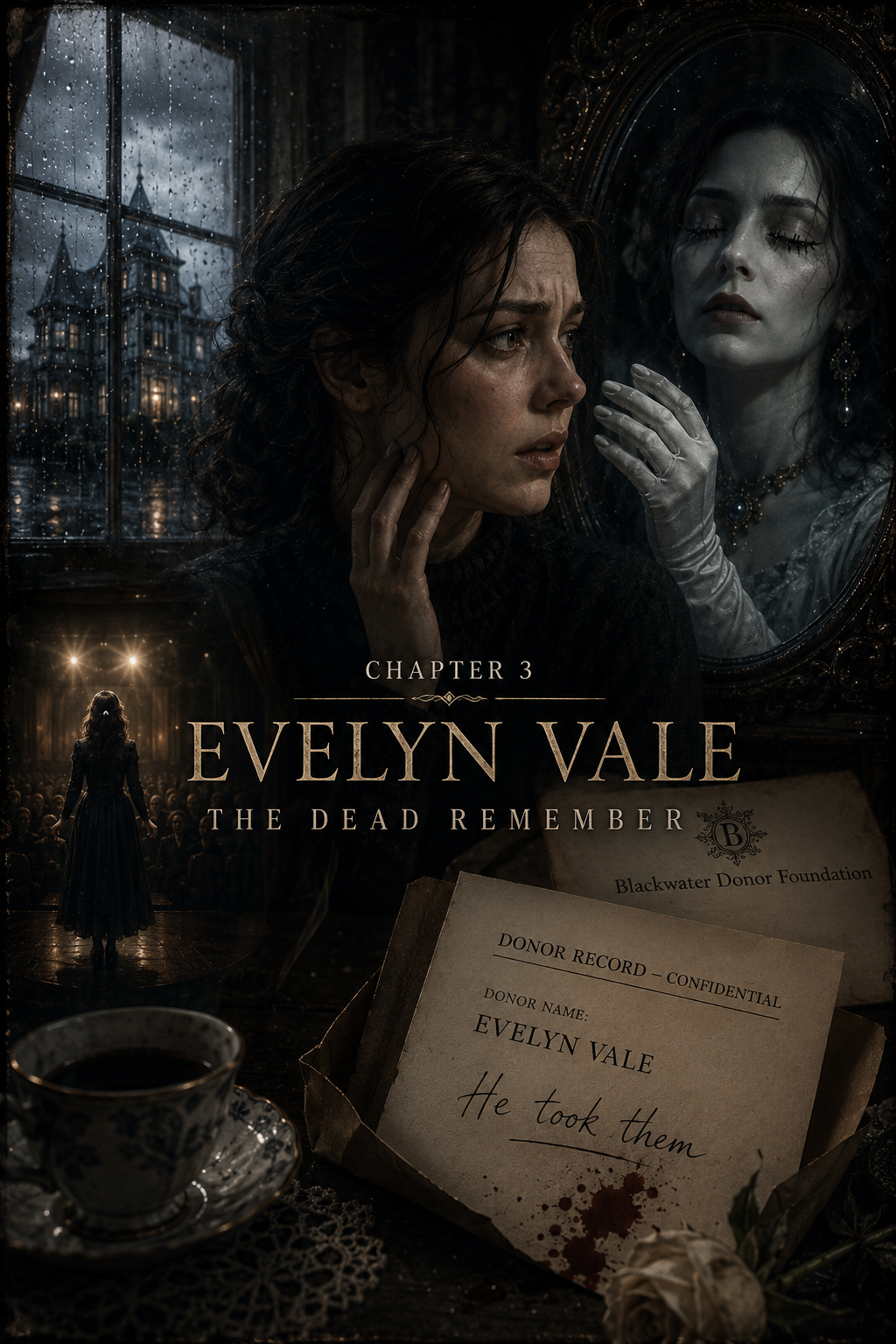
Chapter 3 – Evelyn Vale. The Dead Remember
Amelia woke up choking.
For a violent, disoriented moment, she believed she was still underwater.
She jerked upright beneath the blanket, clawing frantically at her throat and dragged in sharp ragged breaths that burned against her lungs.
The sensation of water still surrounded her.
Darkness swam around her bedroom, shifting gray at the windows while the rain steadily hit the tall windows.
The dream clung to her.
It wasn’t a nightmare, more like a memory. Someone else’s memory.
She pressed her trembling fingers to her mouth, trying to steady herself, reminding herself that she was safe in her room, but her heartbeat was of a thunderstorm beneath her ribs.
The distant sound of an operatic voice lingered in her mind, within the depths, echoing against her skull. Everything had been so vivid–horribly physical–parta of her remained convinced she was still there, beneath the dark waves of the sea. The smell of seaspray, familiar to her, spilled from her lungs as she took deep breaths.
Her nerves tingled up her spine as she shivered.
She felt her sleeves. Damp, not soaked, Sweat, she figured, but it was damp enough to make her stomach tighten uneasily.
Moonlight filtered through the rain-streaked curtains, illuminating the shapes of her bedroom. New to her new eyes. The narrow wardrobe beside the wall. Her dolls sat in their usual place on an upholstered chair. The antique vanity mirror she draped with a pale linen cloth so it wouldn’t reflect anything horrible.
Amelia stared at the mirror for several long seconds. Then quickly looked away.
The groan of the old house’s pipes replaced the nightmare. They shifted behind the walls. Somewhere downstairs, floorboards creaked faintly beneath settling wood.
Or footsteps…
Amelia held her breath.
Silence followed.
She exhaled and swung her legs over the edge of the bed. The house felt colder than usual. The air carrying that damp harbor chill the town never escaped. As she stood, dizziness rolled through her head, followed by a sharp pulse of pain behind her eyes. She grasped the pain pills and swallowed the allotted amount with water beside her bed.
Her mother promised it was temporary, but they were getting worse. Amelia kept it to herself.
Amelia moved toward the bedroom door just as soft footsteps approached from the hallway.
Her mother appeared in the doorway, wrapped in a dark wool robe, silver-threated hair loosely pinned back from sleep.
“Amelia?”
Her mothers voice carried immediate concern, though her expression shifted into immediate calm as soon as she saw her daughter standing upright, looking right at her.
“I heard you moving around.”
“I’m fine, mother,” Amelia said automatically. Her throat was raw from her choking dream that woke her up.
“Did you have a bad dream?”
Amelia nodded and sat back down on her bed. She looked down at her damp sleeves. “It felt real.”
“Of course it did.” Her mother crossed the room gently, tightening her robe against the chill. “Your mind is adjusting to sight. The doctors warned that recovery might be disorientating for a while.”
Her words sounded practiced.
Amelia sighed, “I could feel the water.”
Her mother’s smile tightened faintly.
“Well, dreams do feel real sometimes.”
There was no lingering concern, nor alarm in her voice. Amelia’s stomach churned.
Her mother had kept a strange optimism since the surgery, like she had convinced herself of its success. If she acknowledged anything wrong or frightening, it may somehow undo the miracle.
“Come downstairs,” her mother said softly, “I’ll make some tea.”
The hallways outside remained dimmed except for the weak amber glow from the stairwell below. Amelia meekly followed her mother down the stairs, one hand wrapped around the familiar stair rail. The house smelled faintly of old books, dust, and rain-damp wood.
Amelia had felt the house was her friend, each touch, each smell, each creaking floorboard, spoke softly to her. Now seeing things as they are feels odd. It felt watchful.
Kitchen lights glowed warmly against the grey coming dawn that pressed against the windows. Rain crawled down the glass while the kettle began to talk of violence. Her mother moved through the kitchen with the ease of someone who had seen her entire life. In her restless energy, she put everything out for an early tea and snacks, speaking lightly about ordinary things.
“You should have this tea and bits to eat to settle your stomach, and go back to bed to rest,” she said while spooning tea into a pot, “your body still needs it and we want you completely well.”
Amelia sat quietly at the wooden table.
Something about the room felt wrong. It was subtle. Amelia could quite figure out what it was for sure.
It wasn’t visibly off, or so she thought. She didn’t know for sure.
It was just…off.
The shadows seemed deeper than necessary.
“You’ll feel more like yourself soon,” her mother continued brightly. “Once you are adjusted to seeing. The world is entirely new to you. Of course, everything is going to feel strange. In time, you’ll settle into this newness and find it comforting to be finally able to see.”
Amelia watched her mother.
“You really believe that.”
Her mother turned to her with a quick smile. “I know it.”
The certainty in her voice felt unnerving, more than the dream.
Only the rain and the kettled filled the silence between them.
With a sudden crash–
Applause exploded into Amelia’s mind. She cringed.
Loud.
Thunderous.
Hundreds of hands clapping together in violent approval.
Amelia gasped and dropped her tea cup. Porcelain shattered across the kitchen floor.
The sound vanished as quickly as it appeared.
One moment the applause roared around Amelila like crashing waves inside a grand theater, the next moment there was only the sharp hiss of the kettle at the stove. Tiny fragments of porcelain were scattered across the kitchen floor.
Her breathing turned shallow.
Her mother stared at her daughter, speechless for a moment.
“Amelia—”
“It was loud,” Amelia whispered. “Deafening.”
The words left her before she realized she actually spoke out loud.
Her mother crouched immediately beside the broken pieces, gathering them up carefully into one hand. “You startled yourself.”
“No.” Amelia pressed her trembling fingers against her temple. “I heard something.”
Her mother’s movements slowed only slightly.
“The pipes in this house make strange noises in the rain. You know that.”
“It wasn’t the pipes, mother.”
The sound of applause still echoed faintly in her mind, though now it sounded impossibly distant–as though they belonged to another life.
Hundreds of people clapping.
No.
Not clapping.
Applauding.
Pressure began to bloom behind her eyes.
Amelia winced sharply and lowered her gaze as pain pulsated through her skull in rhythmic waves.
“Another headache?” She asked her daughter gently.
Amelia nodded once.
“You should take some more medication and go back to bed. I’ll bring the tea to you.”
“I am not really tired.”
But she was.
Exhausted in a way sleep no longer seemed capable of fixing.
Eleanor rose with the broken pieces of porcelain laying carefully in her hands. “You have been through a great deal, sweetheart. You can expect pain and disorientation. We both heard what the doctor told us before the surgery. It’s going to be a while before you are normal.”
Normal.
The word sounded strange.
Her mother repeated it often, forcing it into reality–into obedience.
Amelia stood slowly from the table and crossed toward the sink while her mother swept up the remaining fragments, reminding her to be careful. Rain blurred the kitchen window in silver streaks, distorting a dark shape of neighboring buildings beyond the glass.
Without warning, another sensation swept through her.
Warmth.
Bright lights hitting her face.
A suffocating awareness of people watching.
Amelia’s knuckles became white as she gripped the edge of the sink. Holding on for dear life.
Somewhere deep inside her mind, velvet curtains parted.
A woman inhaled shakily in the darkness.
Then came the applause again.
But closer.
Amelia squeezed her eyes shut.
The sound dissolved instantly.
“Amelia?”
She opened her eyes slowly.
Eleanor watched her carefully, concern etched on her pale face. Her optimism fading for a moment.
“What exactly did you hear?”
Amelia hesitated.
How could she explain it? She didn’t understand it herself.
“It felt…” her voice faltered. “Like I was in front of a large group of people, they were all clapping for me.”
Her mother smiled quickly.
“Well, maybe your subconscious is telling you something. You can go out into the world now.”
The explanation felt awkward.
Amelia stared at her mother.
“You don’t think that sounds strange?”
“No stranger than vivid dreams after a major surgery.”
Again.
Too fast.
Too dismissive.
Her mother turned back to the counter before Amelia could answer, busying herself with drying her hands on a dishtowel.
“You’re healing,” she said firmly. “That’s all it is.”
Amelia looked away.
The kitchen felt small.
Too warm.
Amelia moved quietly to the bathroom, needing to create distance between them. The hallway remained dim beneath the early morning light filtering through lace curtains.
The old house creaked.
Somewhere upstairs a floorboard groaned.
The bathroom mirror hung above a small white porcelain sink framed by tarnished brass sconces that cast a soft glow on the tiled floor. Amelia stopped outside, reluctant to step inside.
The mirror reflected only the empty room behind her.
Nothing more. She sighed deeply.
With uneasiness, she turned on the faucet and splashed cold water against her face. Her new eyes still felt swollen and looked like it in the reflection.
The shock of the cold water seemed to steady her nerves.
Then–
Hands touched her cheeks.
Amelia froze.
They were cold, Smooth. Covered in silk or satin.
Long gloved fingers gently cupped her face with impossible tenderness.
The sensation felt horrifyingly real.
Not pressure imagined.
Actual physical touch.
A woman stood close behind her.
Amelia jerked violently backward, striking the sink hard enough to rattle the faucet handles.
The hands vanished instantly.
Her pulse thundered.
“No,” Amelia whispered breathlessly.
The bathroom stood empty.
Only the soft sound of rain tapping against the small frosted window.
Amelia stared toward the mirror.
For one terrible second, her reflection didn’t move.
The woman in the glass remained perfectly still while Amelia stumbled backward in panic.
Then the reflection blinked.
Matching her again.
Amelia pressed trembling fingers against her mouth.
A sudden flash suddenly came into existence in her mind…white opera gloves, pearls against pale skin, a stage bathed in golden light.
Behind the curtain a man watched from the shadows. It made her shake.
The vision disappeared.
A violent stab of pain followed behind her eyes. Her knees nearly buckled. She gripped the sink.
Her mother appeared at the doorway. Amelia barely looked up.
“You’re pale,” her mother said softly.
Amelia laughed under her breath, humorless and frightened.
“I think there is something wrong with me.”
Her mother placed her warm hands on her daughter’s shoulders.
“No,” she said.
The smile reappeared.
“No, sweetheart. Finally something is going right.”
By late afternoon the rain had deepened into a steady storm. Dark violent waves crashed against the rocks. The sound beat through the town.
Water slid endlessly down the house windows while weak gray light settled through the rooms in fading shadows.
Amelia could hear her mother spend most of the afternoon moving restlessly through the house—straightening books already aligned, wiping spotless counters, humming softened beneath her breath as though her ordinary routine could force the day back into a normal shape.
Amelia sat curled under her blanket trying unsuccessfully to sleep.
Every few minutes another pulse of pain tightened behind her eyes, followed by brief flashes she couldn’t predict nor control.
A velvet curtain shifted.
Stage lights burned gold.
The sound of breathing just before applause.
And always that terrible feeling that the memories didn’t belong to her.
Her mothers humming stopped. The house grew quiet.
Amelia closed her new eyes tight. For one fleeting moment she smelled perfume. It wasn’t her mother’s soap. It smelled older, floral and powdery. Like lilies left too long in standing water.
She heard footsteps across the wood floor outside her room. She opened her eyes and there was no one there.
She reclosed her eyes and rubbed her temples beneath the blanket covering her head.
“Still hurting?”
Her mother appeared at the doorway carrying folded laundry against her chest. She came in and put it away in the wardrobe.
“A little,” Amelia admitted quietly. “I keep feeling things.”
She saw her mother stiffen. Amelia felt foolish under her mother’s stare.
Her mother smoothed the wrinkles from the blanket over Amelia’s legs.
“You’ll see,” she said softly. “Soon all of this will feel like a bad dream.
A sharp metal rattle came from the front door. The mail slot had opened and closed quickly.
They could hear the mail drop and scatter on the polished floor.
“Can I get the mail, mother?” Amelia asked in excitement.
Her mother looked at her and gave her a reluctant nod.
Rain and wind whispered through the mail slot as she picked up the mail, gathering them into a neat stack. Bills. Advertisements. Hospital paperwork.
One cream-colored envelope slid loose from the pile.
Amelia’s expression changed.
“Is there anything important, Amelia,” her mother asked from the top of the stairs.
“No, mother,” she replied. “Nothing too important.”
She turned the envelope over once to open it. She figured it was something more about her recovery. Hopefully, all these visions and reflections will be done soon.
The envelope felt expensive. It had embossed silver lettering with the words Blackwater Donor Foundation on the back.
She heard the door of her mothers room open and closed above her.
Inside the envelope was a neatly folded letter. The message was formal and carefully impersonal.
The foundation thanked Amelia for accepting “the extraordinary gift of restored sight” and hoped her recovery continued successfully. There were references to healing, gratitude, and honoring the donor’s legacy through life renewed.
Another folded page slipped loose from inside the letter and drifted to the floor.
The paper looked clinical.
Hospital formatting.
Typed information.
At the very top were written the words: DONOR RECORD – CONFIDENTIAL
Below it: DONOR NAME: EVELYN VALE
As soon as she read the name, the pain exploded behind her eyes. All the same visions flashed in her mind.
Then, something new.
Black seawater swallowed everything whole.
“Amelia?” her mother’s voice sounded far away, distant, hidden behind walls.
The name echoed in her mind.
Evelyn Vale.
Not unfamiliar.
Something known, but forgotten? Amelia didn’t know.
“Evelyn Vale,” Amelia murmured aloud.
Lights of the house flickered. A clap of thunder made the house shake.
Then again.
Silence settled.
Her mother’s pale face appeared in front of her. She stared at the paper.
The smile returned.
Fragile.
Forced.
“Pretty name,” her mother said quickly.
Her mother’s fingers trembled as she took the mail from her.
A sudden ring from the telephone shattered the silence.
Both women were startled and turned with the sudden din.
Her mother answered cautiously.
“Hello?”
A woman’s voice responded at once.
Professional and controlled.
“Mrs. Eleanor Harrow? This is Denise Calloway from St. Dymphna Hospital admistration.”
Amelia’s stomach tightened.
“There seems to be an error involving paperwork sent to your residence.”
Her eyes drifted to the paper in Amelia’s hand.
“You mean Evelyne Vale?”
Silence answered her.
But, not for long.
Her voice now sounded tighter. “Mrs. Harrow…that information was never intended for release.”
Amelia steadied herself as she listened.
“Who was she?” her mother asked.
“I am afraid I cannot discuss donor identities.”
“But you already sent it.”
Another pause. Her mother waited with the phone to her ear, staring at the wall.
To Amelia the world spun. Somewhere deep inside the house, she heard the faint sound of opera music rising softly through the wall.
“You’ll need to return the paperwork immediately,” Denise said carefully. “A courier can retrieve it tomorrow morning.”
Her mother turned to look at her daughter. She stared blankly, fear on her face, down the hall.
Amelia lowered her gaze back down to the paper. Something was written across the bottom margin.
Not typed.
Handwritten.
Elegant black ink.
The handwriting was written by a trembling hand.
Three words: HE TOOK THEM.
Amelia shivered.
Her mother put the phone back on the cradle.
Somewhere behind Amelia in the dark reflection of the hallway mirror–someone softly whispered her name.
Copyright © Rachel D. Knepp 2026