The Letters of the Dead
She noticed it first –the silence–it settled on the world and it made Amelia uneasy. No rain against the windows. No wind rattling the old glass. No distant ship horns drifting through the streets of Blackwater. Even the grandfather clock downstairs seemed to have surrendered its steady ticking.
For several moments, she lay motionless beneath the blankets, listening—hearing nothing.
The previous evening returned in fragments. Sister Agnes Vale. The convent perched above the sea. The terrible account of Evelyn’s death. And the woman in the chapel window, her stitched eyelid slowly pulling apart as though something beneath it were struggling to escape.
Amelia reached toward her face. Her fingertips brushed the delicate skin beneath her eyes, tracing the unfamiliar contours of something she had begun to regard with equal measures of gratitude and dread.
They were Evelyn’s eyes. Not merely similar to them.
The same eyes that had once watched an audience rise in thunderous applause. The same eyes that had looked upon a murderer. The same eyes someone had stolen from a dead woman’s body.
She pressed her palms against them until faint sparks of color flickered behind her closed lids.
A soft knock interrupted her thoughts.
“Amelia?”
Eleanor’s voice sounded unusually subdued.
“Come in.”
Her mother entered carrying a tray with tea and buttered toast. She wore her familiar pale-blue cardigan, though her hair remained uncharacteristically loose around her shoulders.
“You’re awake early.”
“I don’t think I slept much.”
Eleanor set the tray beside the bed and drew back the curtains. Morning light flooded the room causing Amelia to wince.
“Sorry, darling.” quickly readjusted the fabric, leaving only a narrow opening through which the pale November sunlight filtered. For a while Eleanor busied herself arranging the breakfast things. She straightened the teaspoon, adjusted the napkin, and moved the cup closer to Amelia’s hand. It was a familiar ritual, one she had performed throughout her daughter’s life. The sounds Amelia remembered. But Amelia could see now. She could see the tremor in her mother’s fingers.
“Mother?”
“Hmm?”
“Are you frightened?”
Eleanor stopped moving.
“Whatever would give you that idea?”
“Yesterday. At the convent. You hardly spoke on the way home.”
Her mother gave a small, humorless laugh.
“Well, it isn’t every day one hears such dreadful stories.”
“Do you believe Sister Agnes?”
Eleanor flicked a nervous look toward the window. Her voice tone went to just above a whisper
“I believe she loved her sister very much.”
“That’s not what I asked,” Amelia said.
“No,” her mother replied curtly.
Eleanor sat on the edge of the bed. Amelia waited as her mother found her words.
“I believe something terrible happened to Evelyn Vale. But I don’t believe that means something terrible must happen to you,” she finally said.
Amelia studied her mother’s face. She has been studying her face now that she could see. She didn’t seem optimistic to Amelia, but she wasn’t quite sure.
“Then you believe me?”
Eleanor’s eyes made Amelia feel sad. Was this sadness? Or fear?
“I believe you’re frightened, sweetheart. And I believe there are things happening that neither of us understands.”
It was not the answer Amelia wanted, but it was more than her mother had offered before. Eleanor reached for her hand. Amelia felt the familiar warmth in hers. It felt soothing, like before.
“I nearly lost hope that you would ever see the world. Do you know how many nights I prayed for this?”
Amelia nodded. She looked down at her dressing gown and played with the lace trim. It felt hard but flexible in her thin fingers. Amelia loved the intricate cut outs that lined the edges.
“Now you have your sight, and all I can think about is how unhappy you seem.”
“I’m not unhappy,” Amelia replied.
“Then what are you?”
Amelia considered the question. The answer frightened her.
“Someone else,” she whispered.
By midmorning, the house had regained its ordinary sounds.
Eleanor moved downstairs preparing lunch, the radio murmuring softly in the kitchen. A delivery truck rattled along Mercer Street, and somewhere nearby a dog barked insistently at passing pedestrians.
Amelia sat at the small writing desk in her bedroom, her laptop open before her.
She had never learned to read printed words.
For twenty-seven years, letters had existed beneath her fingertips in the raised patterns of Braille, or in the familiar voices of narrators and screen readers. The sudden ability to see printed pages did not grant her an understanding of the strange black symbols arranged across them.
She could recognize certain shapes now. A few letters. Her own name when written in large type, but reading remained a skill she would have to learn. For the moment, the computer’s screen reader remained her most reliable companion. She adjusted the headphones over her ears and opened the browser. The mechanical voice announced the search field. Amelia spoke the name carefully.
“Evelyn Vale.”
The computer repeated it and a list of results followed.
Most were familiar: society notices, charity events, photographs of lavish gatherings at Vale Manor, and articles discussing the young woman’s tragic death.
Amelia listened patiently.
Then she searched for the convent.
Saint Aurelia.
Sister Agnes Vale.
She found a small article describing the convent’s charitable work and another mentioning its long association with the Vale family, but nothing about Evelyn’s murder. Nothing about the missing eyes. Nothing about Dr. Marrow.
Amelia leaned back in her chair. The headaches had become almost predictable now. A dull pressure behind the eyes whenever she concentrated too long, followed occasionally by flashes of light or fragments of images that arrived without warning. She was beginning to distinguish the ordinary pain of recovery from something else. The other pain felt deeper. As though someone were pressing against the inside of her skull.
She removed the headphones. The room seemed unnaturally quiet.
Then she heard it. A faint rustling. Paper shifting against paper.
Amelia turned.
The sound came from the writing desk. An envelope lay near the edge, partly concealed beneath a small stack of Braille correspondence.
She frowned. She did not remember placing it there.
The envelope was cream-colored, its corners softened by age. There was no address. Only a small embossed symbol on the flap. A stylized rose enclosed within a circle.
Amelia picked it up. The paper felt dry and brittle beneath her fingertips.
“Mother?” she called.
No answer.
She opened the envelope carefully. Inside was a folded sheet of stationery that had elegant handwriting, written in dark ink that had faded to brown. Amelia stared at the unfamiliar script. She could see the words, but she could not read them. Frustration rose sharply in her throat. She had spent her entire life imagining what it would feel like to open a letter and read it without assistance. Now she possessed the eyes to see the ink and still needed someone else to give the words meaning.
She reached for her phone. Using its text-recognition function, she positioned the camera over the page and waited for the synthetic voice. At first it read only fragments, then she adjusted the paper beneath the light, and the voice began again.
“My dearest Agnes,”
Amelia froze. The letter was addressed to Sister Agnes.
“I have tried to convince myself that what I witnessed was a misunderstanding. But I know what I saw, and I cannot forget the sound of that woman’s voice.”
A faint chill passed through the room.
“He told me the procedures were necessary. He said the patients had consented, that their suffering would eventually lead to extraordinary discoveries.”
Amelia gripped the edge of the desk.
“But I heard her begging him to stop.”
The computer voice continued in its calm, indifferent cadence. Amelia shivered.
“There are records. Names. Photographs. I have hidden what I could, though I fear he suspects me.”
A sudden pressure bloomed behind Amelia’s eyes made her wince.
“If anything happens to me, please remember that the truth was never meant to remain buried.”
The final sentence was shorter.
“Do not trust the man who promises to make the blind see.”
The room seemed to tilt. Amelia stared at the paper.
Dr. Marrow.
The surgery.
The hospital.
Her hands began trembling and she lowered the letter slowly.
How had it reached her desk?
Sister Agnes had shown them an envelope of letters the previous evening, but Amelia had not taken anything from the convent. She was certain of it.
A soft creak sounded behind her. Amelia turned toward the bedroom door. No one stood there. Yet the air carried the unmistakable fragrance of lilies.
Eleanor found her daughter sitting on the floor beside the desk. The letter lay open across her knees.
“Amelia!” she shouted and hurried toward her.
“What happened?”
Amelia looked up.
“I found something.”
Eleanor knelt beside her.
“Are you hurt?” her voice sounded concerned and loving.
“No,” Amelia replied, not believing her own words.
“Then why are you sitting on the floor?”
Amelia could not remember lowering herself there. She looked toward the letter.
“Read this,” she said, handing the paper to her mother.
Eleanor hesitated before taking the page. Her eyes moved slowly across the handwriting. At first her expression remained neutral. Then her brow furrowed.
“Where did you get this,” she asked. The paper trembled in her fingers.
“It was on my desk,” Amelia said quietly.
“Who brought it?”
“I don’t know.”
Eleanor looked up sharply.
“Amelia,” she remarked sternly–an accusation.
“I’m telling you the truth.”
Her mother returned to the letter. The longer she read, the more troubled she became.
“Good heavens,” she said with a sigh.
“What?” Amelia gazed at her with a pleading gaze.
“This sounds like an accusation.”
“Against Dr. Marrow?” Amelia tried to hold her mothers gaze, but she kept her eyes glued on the page.
“The letter doesn’t mention him by name,” her mother replied.
“But who else could it be?” Amelia grabbed her by the arm and pressed as tight as she could.
Eleanor folded the page carefully and patted her hand calmly.
“Someone who worked at the hospital years ago. Someone involved in Evelyn’s life. We don’t know.”
Amelia stared at her.
“Mother, the letter says he promised to make blind people see.”
“That doesn’t prove anything,” she said, sounding like someone trying to convince herself.
“It proves someone was experimenting on patients,” Amelia said, anguish rising in her voice.
“It suggests someone believed that,” she said without conviction.
Amelia rose unsteadily.
“Why do you always find a way to explain everything away?”
Eleanor recoiled slightly.
“Because I don’t want you destroying yourself over a dead woman!”
The words rang through the room. Both women fell silent. Eleanor closed her eyes.
“I’m sorry,” her mother’s voice fell flat.
Amelia released her arm and looked away, moving back to her bed.
Her mother carefully put the letter back into its envelope and put it onto the desk.
“I know you’re frightened. But you must understand what you’re suggesting. Dr. Marrow gave you your sight.”
“Perhaps he gave me something else.”
Eleanor’s face tightened.
“Don’t say that.”
“Why?”
“Because it’s cruel.”
“To whom?”
“To yourself.”
Amelia looked toward the covered vanity mirror. The pale linen cloth hung motionless over the glass. For a moment she thought she saw the fabric shift. A small movement. As though someone had brushed against it from the other side.
She blinked. The cloth was still.
“Mother,” she said quietly, “I think Evelyn wants me to find out what happened to her.”
Eleanor followed her gaze toward the mirror. Then, without another word, she crossed the room and pulled the cloth more securely over the frame.
Amelia got up as Eleanor left, taking the letter from the desk, she shoved it in the pocket of her cardigan and followed her mother downstairs. She didn’t want the view of the mirror, or any reflective objects. Not ever. But, it was a wish that she didn’t get granted.
Soon after the pale sunset, a vision came to Amelia.
She had been sitting alone in the downstairs parlor while Eleanor prepared dinner. The letter remained folded inside her cardigan pocket, its brittle edges pressing against her ribs whenever she moved.
She had tried calling Saint Aurelia Convent twice, both times the line had been busy. Now she sat listening to the radio, her eyes closed against the persistent ache behind them.
A woman was singing. Not opera. An ordinary popular song playing through the small speaker near the fireplace. Amelia listened without interest. Then the melody changed. The timber deepened. The music’s temp slowed, notes lengthening. A violin entered, followed by the mournful swell of an orchestra.
Amelia opened her eyes.
The radio continued playing. But the room was no longer the Harrow parlor.
She stood in a narrow corridor lined with dark wooden panels. Gas lamps burned along the walls. Somewhere nearby, an audience applauded.
Amelia looked down at her hands, now covered in white satin gloves. A pearl bracelet circled her wrist. Her heart pounded, thump, thump, thump in her skull.
She could feel the fabric against her skin. The unfamiliar weight of jewelry. The pressure of a tightly fitted dress around her waist. She turned toward a mirror hanging beside a doorway.
Evelyn Vale stared back at her. Not as a ghost. Alive. Her dark hair was arranged in an elegant knot, and her gray-blue eyes shone beneath the warm light.
Amelia raised one hand. Evelyn’s reflection did the same.
A door opened behind her. A man stepped into the corridor, but Amelia could not see his face. He stood beyond the reach of the lamps, his dark coat blending into the shadows.
“You shouldn’t have come here,” he said, his voice eerily calm, almost affectionate.
Amelia felt Evelyn’s fear rise inside her like a physical sickness.
“I know what you’ve done.” The words emerged from Amelia’s mouth, though she had not intended to speak.
“You misunderstand.” The man took a step closer.
“I saw the records,” Evelyn’s voice said.
“Then you should have left them where they were.”
A gloved hand reached toward her, but Amelia stepped backward and the corridor vanished. She began to run, rain striking her face, shoes slipping against wet cobblestones. Behind her came the rapid footsteps of someone pursuing her. The pearl necklace snapped, sending small white beads scattered across the pavement.
Amelia stumbled. A hand seized her wrist and a scream escaped her mouth, as the world lurched sideways.
For an instant she saw the harbor beneath her, black water churning between stone pilings.
Then fingers closed around her throat. The pressure was unbearable. She fought desperately, clawing at the hands holding her. The man’s face moved closer. Still hidden. Still impossible to recognize. Then he spoke.
“You should have kept your eyes closed.”
Amelia gasped and the vision shattered.
She was back in the parlor. The radio played softly beside the fireplace and her hands gripped the arms of the chair. She could not breathe or had stopped breathing. For several terrifying seconds, she felt fingers pressing against her throat. Then the sensation faded.
Amelia staggered to her feet. Across the room, the tall mirror above the mantel reflected the parlor in dim amber light. A woman stood behind her chair.
Evelyn.
Her white dress dripped steadily onto the carpet, her stitched eyelids remained closed, but her head was turned toward the hallway, toward the front door.
Amelia followed the direction of her gaze. A knock sounded. Three slow, deliberate blows.
Amelia froze.
From the kitchen Eleanor called, “Would you see who that is, darling?”
The knocking came again. Amelia moved toward the hallway. Her legs felt strangely weak. She opened the door.
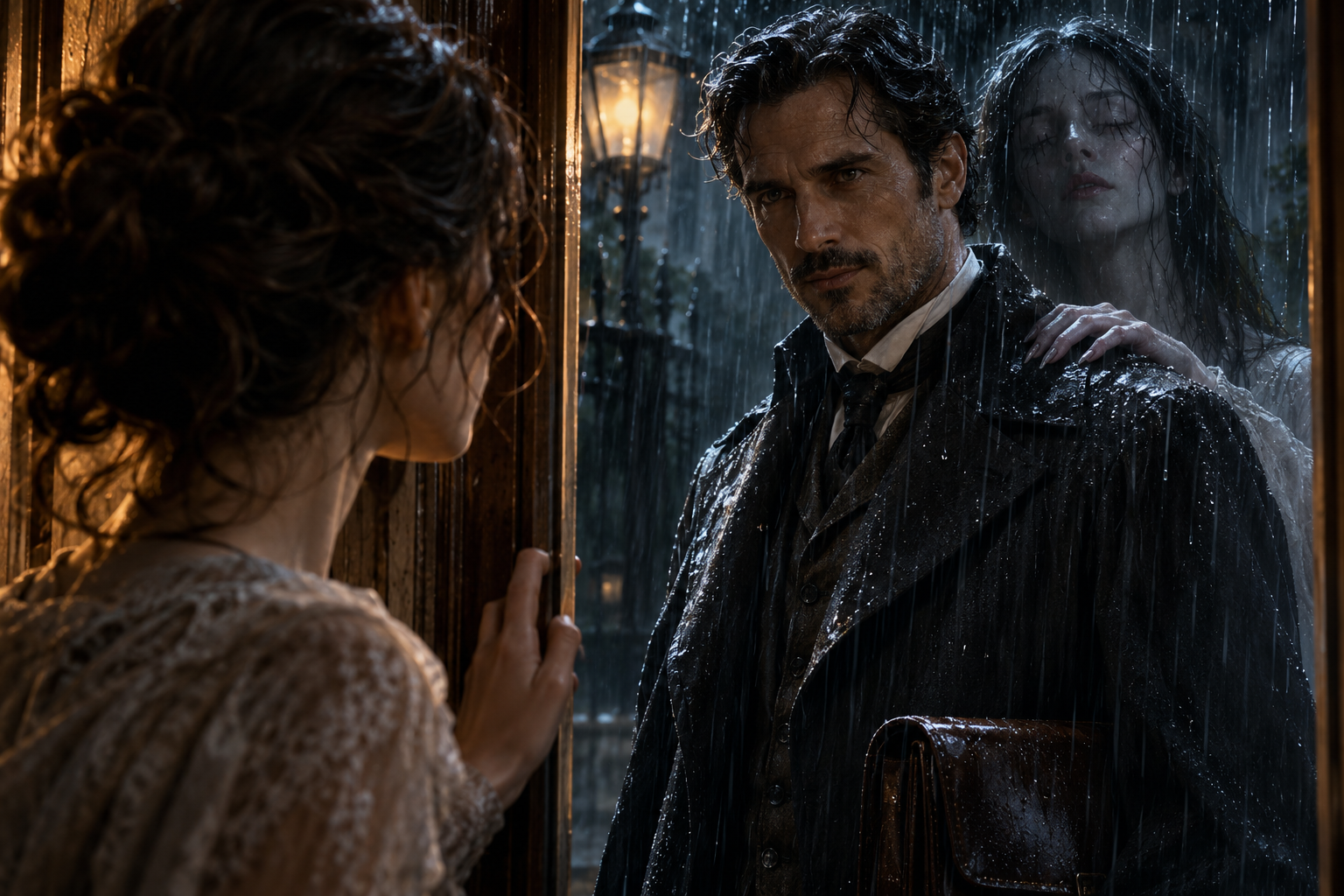
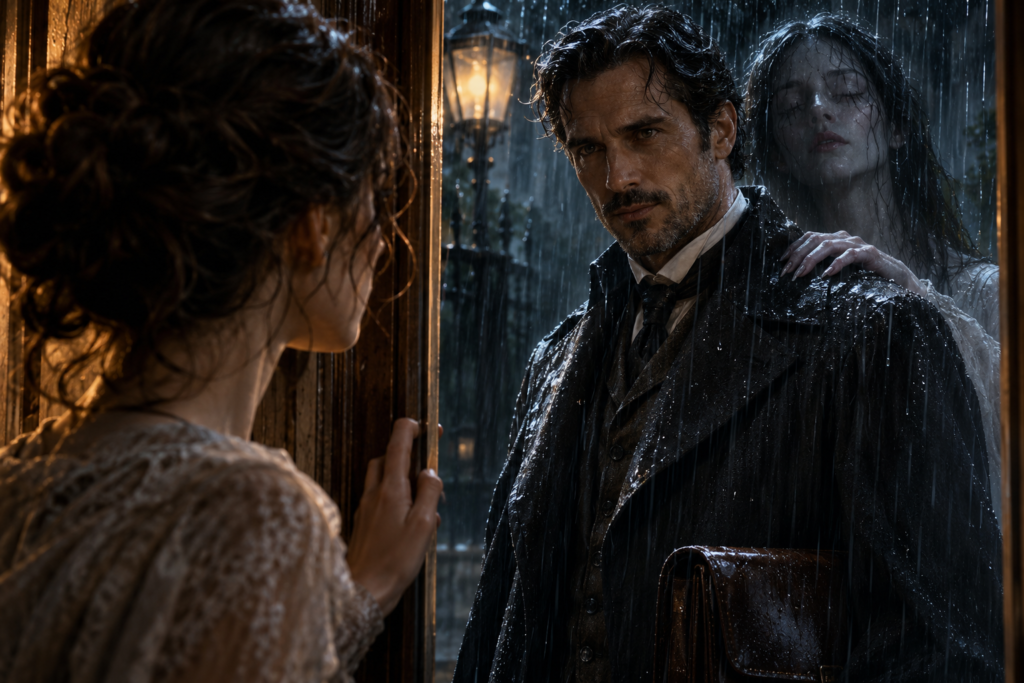
A man stood beneath the porch light.
He wore a dark overcoat and held a leather briefcase in one hand. Rain glistened across his shoulders, and his expression was composed beneath the shadow of his hat.
“Miss Harrow?”
Amelia nodded.
“Yes?”
The man offered a small, professional smile.
“I’m Dr. Marrow.”
The name struck her like a physical blow.
“I understand you’ve been having some difficulties since the surgery.”
Amelia gripped the edge of the door. Behind her, the grandfather clock began ticking again.
Dr. Marrow glanced past her into the dark hallway.
“May I come in?”
Amelia did not answer, because in the narrow glass panel beside the front door, she could see his reflection and standing directly behind him was Evelyn Vale, her pale hands rested upon his shoulders, her stitched face hovered beside his ear. Slowly, impossibly, the dead woman’s lips began to move.
Amelia heard the words clearly.
He remembers me.
Now, in that moment of time, since the visions started, Amelia was more frightened of the living than the dead.
Copyright © Rachel D. Knepp 2026